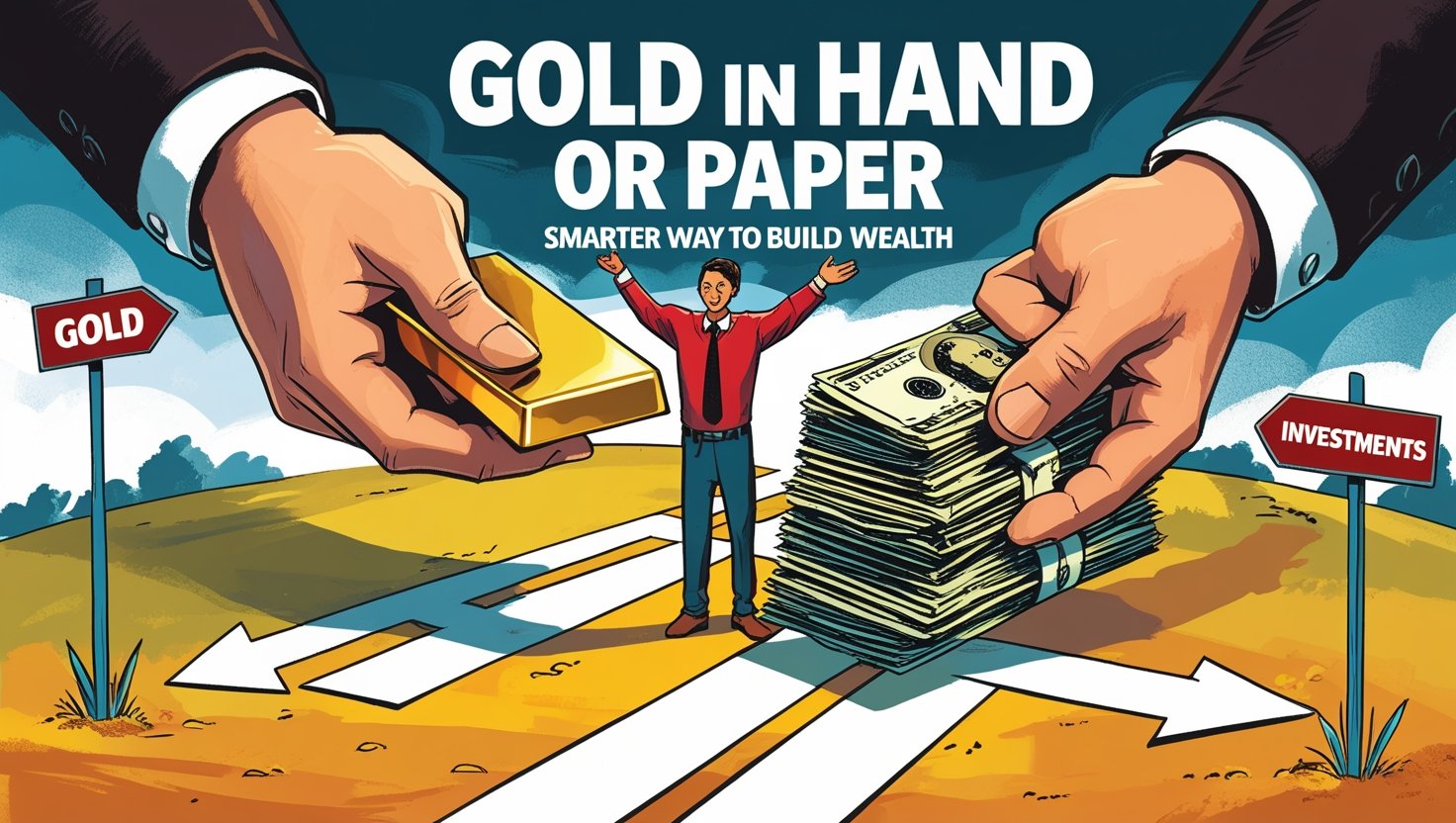
Gold in Hand or Paper | Smarter Way to Build Wealth
Picking how to build your wealth often feels like a big puzzle. Should you put your money into solid gold, something you can touch and hold? Or is it better to invest in “paper assets” like stocks and bonds, which promise growth but exist mostly on a screen? This old question pits the comfort of tangibility against the exciting chance for financial growth. This article explores what makes gold special and why paper assets are powerful. We will look at their past performance and today’s economic forces. Then, you can see how to combine them for your best path to financial success.
The Enduring Appeal of Gold:
Gold has long held a special place in people’s minds. It offers a sense of safety that paper assets sometimes lack. This shiny metal has served as a medium of exchange for thousands of years.
Gold as a Store of Value:
People often turn to gold during rough economic times. It acts as a safe place for money when prices are rising quickly. For instance, in the 1970s, when inflation was high, gold’s price soared, protecting people’s buying power. Many see it as a shield against big ups and downs in the market. It often holds its value when other investments fall.
Gold as a Portfolio Diversifier:
One big reason to own gold is how it acts differently from stocks and bonds. Gold’s price usually moves in its own way, not always with the stock market. This low connection can make your whole investment pot less bumpy. During the 2008 financial crisis, for example, many stocks dropped sharply, but gold generally went up. This shows how gold can help balance out your risks.
The Practicalities of Owning Gold:
There are a few ways to own gold. You can buy physical gold like coins or bars, which you can hold in your hand. This gives you direct ownership, but you need to think about safe storage and insurance. You can also invest in gold through exchange-traded funds (ETFs) that track gold’s price, or by buying shares in gold mining companies. When buying physical gold, always use trusted dealers and learn about assay marks, which show the gold’s purity. Make sure your storage is secure, like a bank safe deposit box.
The Power of Paper Assets:
While gold offers stability, paper assets are often where you find big growth. These financial tools let your money work for you in different ways. They typically focus on growing your wealth over time.
Stocks: The Engine of Capital Appreciation:
Owning stocks means you own a small piece of a company. As companies grow and do well, the value of your shares can go up significantly. This lets you take part in the success of the economy and new inventions. Historically, major stock markets, like the S&P 500, have shown strong long-term returns, even with ups and downs. Financial experts often point to stocks as the best way to build wealth over many years.
Bonds: Stability and Income Generation:
Bonds offer a different benefit than stocks. When you buy a bond, you’re lending money to a government or a company. In return, they promise to pay you back your money plus regular interest payments. Bonds are generally less risky than stocks and can provide a steady income stream. They help balance out a portfolio, especially when you need more dependable returns or want to protect your original investment. Their performance can change with interest rates, but they often act as a stable base.
Diversification Within Paper Assets:
Spreading your money around is key, even within paper assets. Don’t put all your money into just one company or one type of stock. Instead, invest in many different industries, from tech to healthcare, and in companies from various countries. This helps lower your risk if one area struggles. You can do this easily through mutual funds or ETFs, which hold many different stocks or bonds. These funds allow you to own a piece of many companies without buying each one separately.
Historical Performance: Gold vs. Paper in Different Eras:
Understanding how gold and paper assets behaved in the past helps us plan for the future. Their performance often depends on the overall economic climate. Some periods favor one over the other.
Economic Downturns and Recessions:
Gold tends to shine when the economy is struggling. During times of high inflation or when markets crash, gold often becomes a preferred safe haven. For instance, in the 1970s, when prices were soaring and the economy was slowing, gold’s value rose sharply. The 2008 financial crisis also saw gold prices climb as stocks tumbled. People often flock to gold for its perceived stability when money seems less certain.
Periods of Economic Growth:
On the flip side, paper assets, especially stocks, generally do much better during times of economic expansion. When companies are growing, making profits, and creating jobs, their stock prices usually go up. During long bull markets, like the one in the 1990s or after the 2008 crisis, stock indices have shown impressive gains. Gold typically takes a back seat when the economy is booming and inflation is low.
The Impact of Interest Rates and Monetary Policy:
Central banks play a big role in how gold and paper assets perform. When interest rates are low, bonds offer less income, making stocks more appealing. Low rates can also make gold more attractive because it doesn’t pay interest. But when rates go up, bonds become more competitive, and holding gold might seem less rewarding. Governments printing more money (quantitative easing) can also make gold look good as a hedge against inflation.
Current Economic Landscape: What’s Driving the Decision?
Today’s world has its own set of unique financial challenges and opportunities. These current conditions should factor into your wealth-building choices. We are seeing some interesting shifts in the market right now.
Inflationary Pressures and Geopolitical Uncertainty:
Right now, many parts of the world are seeing higher prices for goods and services. Supply chain issues and global events are contributing to this. These inflationary pressures often make gold more appealing. Also, ongoing tensions between countries can make investors nervous. During such times, gold is often seen as a reliable store of value when other assets feel risky. Experts watch these global forces closely for their impact on asset prices.
Interest Rate Hikes and Market Volatility:
Central banks have been raising interest rates to combat inflation. Higher interest rates make borrowing more expensive for companies and can make bond yields more attractive. This can sometimes make stocks less appealing, as their future earnings might be worth less today. This shift also makes gold’s non-yielding nature less favorable compared to rising bond returns. Market swings are common during these periods, keeping investors on edge.
Technological Advancements and Market Trends:
New technologies are always popping up and changing how we live and work. Companies at the forefront of these changes, like those in artificial intelligence or renewable energy, can offer amazing growth opportunities for stock investors. These breakthroughs can create entirely new industries and reshape old ones. This continuous innovation makes paper assets, especially stocks in growing sectors, a dynamic part of the wealth-building equation.
Crafting Your Smarter Wealth-Building Strategy:
Building wealth isn’t a one-size-fits-all journey. Your strategy should be personal and reflect your own situation. It should start with understanding what you want and how much risk you can handle.
Defining Your Financial Goals and Risk Tolerance:
Before you invest, think about what you want your money to do for you. Are you saving for retirement, a down payment on a house, or something else? Knowing your goals helps you pick the right investments. You also need to figure out your risk tolerance. How many ups and downs can you handle without losing sleep? Answering these questions helps you choose assets that fit your comfort level. Take some time to write down your financial targets clearly.
Strategic Allocation: Finding the Right Mix:
Once you know your goals, you can decide how much of your money goes into gold and how much into paper assets. Younger investors with many years until retirement might choose more stocks for growth. Someone closer to retirement might lean more on bonds for stability and gold for protection. For example, a younger investor might have 80% in stocks, 10% in bonds, and 10% in gold. An older investor might have 40% in stocks, 40% in bonds, and 20% in gold. The key is finding a mix that feels right for you.
Rebalancing and Long-Term Perspective:
Your investment mix shouldn’t stay the same forever. It’s smart to check your portfolio regularly, maybe once a year. If one asset, like stocks, grows a lot, it might become a bigger part of your portfolio than you planned. Rebalancing means selling a little of what has grown and buying more of what has fallen. This helps keep your desired mix and manage risk. Remember, building wealth is a marathon, not a sprint. Staying focused on the long-term helps you ride out short-term market changes.
Conclusion:
The debate between holding gold in your hand or investing in paper assets is ongoing. Gold offers a solid, tangible value and acts as a shield during rough economic weather. Paper assets, especially stocks, provide the engine for growth and the chance for regular income. Bonds bring stability and capital preservation to your portfolio.
The “smarter way” to build wealth is not to pick a side. Instead, it involves blending both gold and paper assets carefully. Your unique financial goals, how much risk you’re willing to take, and the current state of the economy should guide your choices. By mixing these different assets wisely, you create a stronger, more balanced investment approach. This thoughtful strategy helps you navigate various market conditions and moves you closer to your financial dreams.
FAQs:
1. Is gold a better investment than stocks or bonds?
Not necessarily. Gold is great for stability, especially in uncertain times, but stocks and bonds usually offer higher returns over the long term.
2. What’s the safest way to invest in gold?
The safest method is buying physical gold from trusted dealers and storing it securely, like in a bank’s safe deposit box. Gold ETFs are also a safe, low-maintenance option.
3. Can I build wealth faster with paper assets?
Yes, paper assets—especially stocks—can grow your wealth faster due to their growth potential. But they also come with a higher risk.
4. Why should I invest in both gold and paper assets?
Combining both adds balance. Gold protects during downturns, while paper assets offer growth and income during good times.
5. How often should I rebalance my portfolio?
At least once a year. Rebalancing helps keep your investments aligned with your goals and risk tolerance.
6. What if I’m close to retirement? Should I still invest in stocks?
Yes, but with caution. Consider a mix that includes more bonds and some gold for stability, while keeping a smaller portion in stocks for growth.